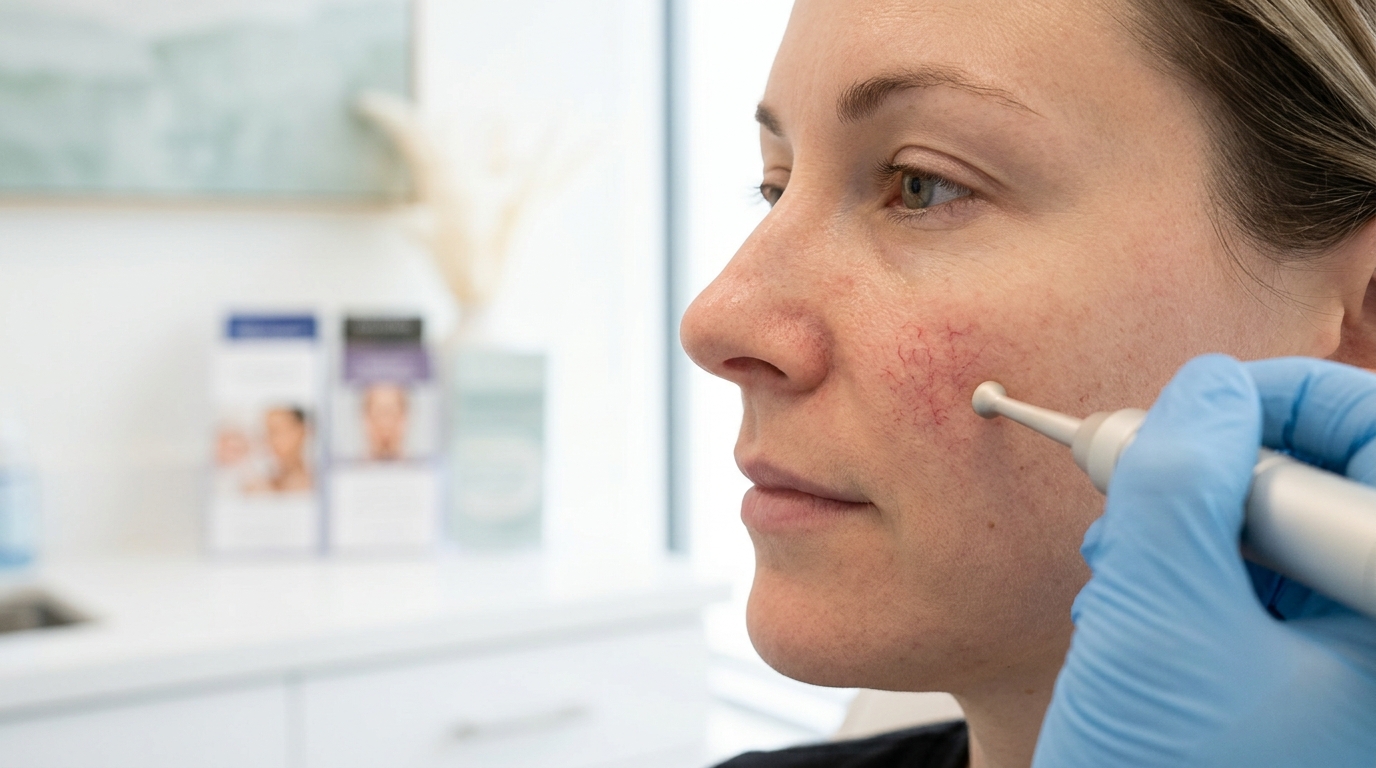
Broken capillaries are the small, visible red or purple lines that show up on your face. They affect millions of adults and can appear despite diligent skincare. Laser treatment for broken capillaries uses targeted light energy to collapse the damaged vessels, allowing your body to naturally reabsorb them over time. If you've noticed persistent facial redness or spider veins that don't respond to topical care, understanding your laser options and what the treatment process involves can help you decide whether this approach fits your skin goals.
This guide walks you through the causes of facial broken capillaries, how different laser technologies address them, what to expect during treatment and recovery, and how to maintain your results long-term.
What Causes Broken Capillaries on the Face?
Broken capillaries develop when delicate facial blood vessels become dilated and damaged, remaining visible beneath the skin's surface. Common triggers include chronic sun exposure, which weakens vessel walls over time; genetic predisposition to vascular skin conditions like rosacea; hormonal fluctuations during pregnancy or menopause; temperature extremes that repeatedly constrict and dilate vessels; alcohol consumption, which causes temporary flushing that can become permanent; facial trauma or aggressive skincare; certain medications including topical steroids; and underlying conditions such as rosacea or lupus.
The facial areas most susceptible to broken capillaries include the cheeks, nose, chin, and around the nostrils. These are zones where vessels sit close to the skin's surface and experience the most environmental exposure. Sun damage remains the leading preventable cause, with UV radiation degrading the collagen and elastin that support vessel walls.
Hormonal changes deserve special attention. During pregnancy, increased blood volume and estrogen levels cause many women to develop new broken capillaries, particularly on the cheeks and nose. While some pregnancy-related vessels fade postpartum, many persist without intervention. Similarly, perimenopause and menopause can trigger new vascular changes as estrogen levels fluctuate.
Lifestyle factors compound genetic vulnerability. Regular alcohol consumption causes repeated facial flushing episodes that stretch vessel walls. Over time, these vessels lose their ability to contract normally and remain visibly dilated. Extreme temperature exposure creates a similar pattern of repeated dilation, whether it comes from harsh winters, hot yoga, frequent sauna use, or working near heat sources. Over time that dilation can become long-lasting.
Certain skincare practices can trigger or worsen broken capillaries. Aggressive mechanical exfoliation, harsh chemical peels performed too frequently, and long-term use of potent topical steroids can all thin the skin and weaken vascular walls. If you have a family history of rosacea or visible facial veins, these practices carry even greater risk.
Understanding your specific triggers helps prevent new broken capillaries from forming after treatment. A consultation with an experienced provider can identify whether your vessels stem primarily from sun damage, rosacea, hormonal changes, or lifestyle factors. That information shapes both your treatment plan and your maintenance strategy.
How Does Laser Treatment Remove Broken Capillaries?
Laser treatment removes broken capillaries through selective photothermolysis, a process where specific wavelengths of light target hemoglobin inside the damaged blood vessels while leaving surrounding tissue unharmed. The laser energy heats the blood within the vessel, causing the vessel walls to collapse and seal shut. Over the following weeks, your body's immune system gradually breaks down and removes the collapsed vessel through natural metabolic processes, causing the visible redness to fade.
The principle relies on wavelength selectivity. Hemoglobin, the oxygen-carrying protein in red blood cells, absorbs certain wavelengths of light energy particularly well. When practitioners deliver these specific wavelengths at the right intensity and pulse duration, the energy converts to heat within the targeted vessel. This controlled heating damages the vessel walls enough to trigger collapse without creating burns or scars in the surrounding dermis.
Pulse duration plays a critical role in treatment safety and effectiveness. Vascular lasers use pulses measured in milliseconds, timed to match the thermal relaxation time of facial blood vessels, which is the interval it takes for heat to dissipate from the targeted structure. Pulses delivered within this window heat the vessel sufficiently to cause collapse while allowing adjacent tissue to remain cool. This precision explains why modern vascular lasers can treat even fine facial capillaries with minimal risk of scarring or pigmentation changes.
The body's natural clearance process takes time. After the laser collapses a vessel, your lymphatic system and immune cells gradually remove the damaged tissue over 4 to 8 weeks. During this period, treated vessels may initially appear darker as the trapped blood absorbs, then progressively lighten as the body reabsorbs the material. Some vessels respond completely after a single session, while others require multiple treatments to achieve full clearance. We cover those factors in detail later in this guide.
Treatment depth varies by vessel size and location. Superficial capillaries close to the skin's surface often respond quickly and completely. Deeper vessels or those with stronger blood flow may require more aggressive settings or additional sessions. An experienced provider assesses vessel depth, diameter, and location during your consultation to select the optimal laser wavelength and parameters for your specific presentation.
The American Society for Dermatologic Surgery describes the same process in plain terms: the laser "transmits photons that are absorbed by the blood cells in the veins, which generates heat that destroys the blood vessel," after which "the damaged vein shrinks and eventually dissolves over time." The ASDS considers laser and light therapy the treatment of choice for facial spider veins, and notes that multiple treatments may be required.
What Types of Lasers Treat Broken Capillaries?
Multiple laser and light-based technologies effectively treat broken capillaries, each with distinct wavelengths, mechanisms, and ideal applications. Pulsed dye laser (PDL) uses a 595 nm wavelength specifically absorbed by hemoglobin, making it the gold standard for superficial facial vessels and the system most extensively studied in clinical literature. Intense pulsed light (IPL) delivers broad-spectrum light (500 to 1200 nm) that targets both hemoglobin and melanin, making it versatile for mixed redness and pigmentation but less selective than true lasers.
Nd:YAG lasers emit 1064 nm wavelengths that penetrate deeper into the dermis, making them ideal for larger, deeper vessels and safe for darker skin tones that risk pigmentation changes with shorter wavelengths. KTP (potassium-titanyl-phosphate) lasers produce 532 nm green light strongly absorbed by superficial red vessels, effective for very fine capillaries but limited to lighter skin types due to melanin absorption at this wavelength.
At Body+Beauty Lab, our Pennsylvania and Florida locations offer vascular laser and light treatments including Nordlys IPL, Candela VBeam vein treatment (a pulsed dye laser), and IPL and BBL broadband light treatments. Dr. Benjamin Lam and the Pennsylvania team carefully assess vessel size, depth, and skin type during consultation to determine which technology best matches your presentation and goals.
Pulsed Dye Laser (PDL) remains the most studied and widely used option for facial broken capillaries. The 595 nm wavelength falls within hemoglobin's peak absorption spectrum, allowing highly selective targeting. Modern PDL systems incorporate dynamic cooling devices that protect the skin's surface while the laser heats vessels beneath. Temporary purpura (bruising) can occur with aggressive settings but usually resolves within 7 to 10 days.
Intense Pulsed Light (IPL) offers versatility for patients with both vascular and pigmented concerns. The broad-spectrum output allows practitioners to customize wavelength ranges using filters, addressing redness, sunspots, and texture in combined treatments. IPL typically requires more sessions than PDL for vascular clearance, often 4 to 6 treatments, but it delivers broader skin-quality improvements. IPL works best on Fitzpatrick skin types I to III; darker skin tones risk post-inflammatory hyperpigmentation.
Nd:YAG lasers excel at treating deeper or larger facial vessels that don't respond fully to PDL or IPL. The 1064 nm wavelength penetrates 5 to 6 mm into tissue, reaching reticular veins and deeper vascular structures. Because this wavelength is less absorbed by melanin, Nd:YAG safely treats darker skin tones (Fitzpatrick types IV to VI) with lower risk of pigmentation changes. Treatments may feel more uncomfortable than PDL due to deeper tissue heating, but produce minimal surface bruising.
KTP lasers target the finest, most superficial broken capillaries with 532 nm green light. This wavelength sits at hemoglobin's secondary absorption peak, making it highly effective for delicate facial vessels, particularly around the nose and inner cheeks. KTP treatments involve minimal downtime, usually just transient redness lasting a few hours. However, the shorter wavelength carries higher melanin absorption, limiting use to fair skin types.
The choice among these options depends on your vessel characteristics, skin type, treatment goals, and tolerance for downtime. Some patients benefit from sequential treatments, starting with PDL for major vessels, then refining with IPL for residual background redness and texture.
How Many Laser Sessions Are Needed for Broken Capillaries?
Most patients require 3 to 5 laser sessions spaced 4 to 6 weeks apart to achieve optimal clearance of facial broken capillaries, though individual results vary based on vessel size, depth, density, and the laser technology used. Fine, superficial capillaries often show 50 to 70% improvement after the first treatment, while larger or deeper vessels may need the full treatment series to achieve comparable results. Your provider assesses response after each session and adjusts parameters or session numbers accordingly.
Several factors influence the number of treatments you'll need. Vessel diameter plays a significant role. Capillaries under 0.5 mm often respond to 2 to 3 sessions, while vessels 1 to 3 mm in diameter may require 4 to 6 treatments. Treatment technology matters: PDL typically achieves clearance in fewer sessions than IPL for purely vascular concerns. Skin type affects treatment aggressiveness; fair skin tolerates higher energy settings that may reduce total session numbers, while darker skin requires more conservative parameters and potentially more treatments to avoid pigmentation changes.
Underlying conditions like rosacea complicate treatment planning. Active rosacea continually generates new broken capillaries, meaning treatment focuses on managing existing vessels while concurrent rosacea therapy (topical or oral medications) addresses the root inflammatory process. Patients with rosacea often need ongoing maintenance treatments every 6 to 12 months even after initial clearance, rather than achieving permanent resolution.
Realistic session-by-session expectations help you track progress:
- After session 1: Treated vessels appear darker initially (trapped blood), then fade 30 to 50% over 4 to 6 weeks. Surrounding redness may improve as inflammation decreases.
- After session 2: Cumulative improvement reaches 60 to 75% for responsive vessels. Some fine capillaries may have completely cleared, while larger vessels show significant lightening.
- After session 3: Most superficial vessels show 80 to 90% clearance. Deeper or more resistant vessels continue to fade but may require additional sessions.
- After sessions 4 to 5: Final refinement addresses stubborn vessels. Overall redness and vascular visibility typically improve 85 to 95% compared to baseline.
Treatment intervals matter. Spacing sessions 4 to 6 weeks apart allows your body time to clear collapsed vessels and your skin to heal completely before the next treatment. Scheduling sessions too close together increases inflammation risk without improving outcomes, while intervals longer than 8 weeks may slow overall progress.
Some vessels may never completely disappear, particularly in patients with active rosacea, ongoing sun exposure, or strong genetic predisposition. In these cases, maintenance treatments every 6 to 12 months help sustain improvement. Your provider discusses long-term management strategies after your initial treatment series.
What Is the Recovery Time After Laser Treatment for Broken Capillaries?
Recovery after laser treatment for broken capillaries is minimal for most patients, with typical downtime ranging from a few hours to 7 days depending on the laser type and treatment settings used. Most people return to normal activities immediately, though temporary redness, mild swelling, and occasional bruising are common in the treated areas. These effects resolve on their own as your skin heals and your body clears the collapsed vessels.
Immediate post-treatment effects include warmth and redness in treated areas, similar to a mild sunburn. This typically peaks within 2 to 4 hours after treatment, then gradually subsides over 24 to 48 hours. Applying cold compresses and gentle moisturizer helps soothe discomfort during this period. Some patients experience mild swelling, particularly when treating the nose or under-eye area; this usually resolves within 24 hours and can be minimized by sleeping with your head slightly elevated the first night.
Pulsed dye laser (PDL) treatments may cause purpura, a temporary purple bruising, especially when higher energy settings are used for stubborn vessels. This bruising results from red blood cells leaking from collapsed vessels and typically lasts 7 to 10 days. Many practitioners now use lower-energy "subpurpuric" settings that minimize bruising while still achieving good results, though this approach may require additional sessions. If your lifestyle or work makes bruising problematic, discuss subpurpuric protocols during your consultation.
IPL treatments usually produce minimal visible recovery signs: transient redness lasting a few hours and occasional mild swelling. Treated vessels may appear darker for 1 to 2 weeks as trapped blood absorbs before fading. You can typically apply makeup the next day to conceal any residual redness.
Nd:YAG treatments create little surface change despite treating deeper vessels. Expect redness and warmth for several hours, but rarely bruising. Some patients report a mild "tight" sensation in treated areas for 1 to 2 days as deeper tissue heals.
KTP treatments involve the shortest recovery, often just a few hours of pinkness. Because these lasers target only the most superficial vessels, surrounding tissue experiences minimal trauma.
Post-treatment care significantly influences your healing timeline and results. For the first 48 hours, avoid hot showers, exercise, alcohol, and anything that increases facial blood flow and could cause treated vessels to dilate before they're fully sealed. Use gentle, fragrance-free cleansers and moisturizers. Apply a broad-spectrum, water-resistant SPF 30 or higher every day, reapplying roughly every two hours outdoors, as treated skin is temporarily more vulnerable to UV damage. Avoid active skincare ingredients like retinoids, AHAs, and BHAs for 3 to 5 days, resuming only when redness has completely resolved.
Most patients schedule treatments on Thursday or Friday, allowing weekend recovery time before returning to work. If your provider uses purpuric PDL settings, plan for up to 10 days before important events. For subpurpuric or IPL treatments, next-day social activities are usually manageable with mineral makeup if desired.
Complications are rare when treatments are performed by experienced providers. Temporary hyperpigmentation can occur, particularly in darker skin types or with excessive sun exposure during healing. This usually resolves within 8 to 12 weeks with diligent sun protection and may be minimized with post-treatment brightening serums. True scarring is extremely rare with modern vascular lasers when appropriate parameters are used.
The Pennsylvania team at Body+Beauty Lab, including Sarah Sidiqi, Alison Palmer, and the experienced aesthetics staff, provides detailed pre and post care instructions personalized to your laser type and treatment area. In Florida, Dr. Leslie Baumann and the Bay Harbor Islands and West Palm Beach teams offer the same careful guidance, ensuring you know exactly what to expect and how to optimize your healing.
Plan for gradual improvement rather than instant results. While some redness diminishes within days, full vessel clearance takes 4 to 8 weeks as your body reabsorbs the collapsed vessels. Patience during this remodeling phase allows the treatment to work as intended and helps you accurately assess when your next session should be scheduled.
Cost Considerations and Treatment Investment
Understanding the financial investment for broken capillary treatment helps you plan your care realistically. Laser treatment costs vary based on geographic location, provider experience, technology used, and treatment area size. In major metropolitan areas like Philadelphia and West Palm Beach, per-session costs typically range from $250 to $600, with smaller treatment areas (isolated nose or cheek capillaries) at the lower end and full-face vascular treatments at the higher end.
Most patients investing in a complete treatment series of 3 to 5 sessions should budget $900 to $2,500 total. This investment often compares favorably to years of concealing makeup and the ongoing cost of topical products that don't address the underlying vessels. Some practices offer package pricing that reduces per-session costs when multiple treatments are purchased upfront.
Insurance rarely covers laser treatment for broken capillaries, as carriers typically classify these as cosmetic procedures. However, if your broken capillaries result from an underlying medical condition like rosacea, and your dermatologist documents medical necessity, partial coverage may be possible, though this remains uncommon. Check with your provider's billing staff to explore any coverage options before beginning treatment.
Membership programs may offer cost advantages for patients planning multiple sessions or combining vascular treatments with other skin services. Body+Beauty Lab's Pennsylvania membership options provide monthly credits toward services, which can help offset the cost of a multi-session treatment plan.
When evaluating cost, consider the provider's experience and technology quality alongside price. The American Academy of Dermatology puts it bluntly: "In inexperienced hands, laser therapy, light treatments, or electrodesiccation can be dangerous. Burns, permanent changes to your skin color, or scars can occur." Experienced practitioners deliver safer, more effective treatments that may require fewer total sessions than less experienced providers. At Body+Beauty Lab that includes medical directors Dr. Benjamin Lam in Pennsylvania and Dr. Leslie Baumann in Bay Harbor Islands, alongside skilled injectors and laser technicians. Advanced laser systems with proper cooling, adjustable parameters, and proven clinical track records reduce complication risk and improve outcomes, justifying their associated costs.
Prevention and Maintenance After Treatment
Successfully treating existing broken capillaries is only half the equation. Preventing new vessels from forming preserves your results and minimizes the need for future sessions. Prevention strategies address the same triggers that caused your initial capillaries: sun protection, rosacea management, skincare adjustments, and lifestyle modifications.
Sun protection is non-negotiable, because daily sunscreen limits the UV-induced collagen degradation that weakens vessel walls. The American Academy of Dermatology recommends a sunscreen that is broad spectrum, SPF 30 or higher, and water resistant, noting that an SPF 30 blocks 97 percent of the sun's UVB rays. Reapply roughly every two hours outdoors, or after swimming or sweating, and pair it with wide-brimmed hats for high-exposure activities. Mineral sunscreens containing zinc oxide or titanium dioxide are particularly suitable for sensitive, redness-prone skin, as they sit on the skin's surface and cause less irritation than chemical filters.
Rosacea management requires partnership with a dermatology provider. Prescription topicals like azelaic acid, metronidazole, or ivermectin help control the inflammation that generates new broken capillaries. Oral medications (doxycycline, isotretinoin) may be appropriate for moderate to severe cases. Identify and avoid your personal rosacea triggers. Common culprits include spicy foods, hot beverages, alcohol, temperature extremes, and stress.
Skincare adjustments protect fragile facial vessels. Choose gentle, fragrance-free cleansers that don't strip your skin's protective barrier. Avoid physical exfoliants, harsh scrubs, and mechanical brushes that create surface trauma. When using active ingredients like retinoids or AHAs, start with lower concentrations and less frequent application, gradually increasing only as your skin tolerates. If you notice persistent flushing or new redness after introducing a product, discontinue use.
Temperature moderation prevents repeated vessel dilation. Wash your face with lukewarm water rather than hot. Limit sauna and hot yoga frequency if you notice worsening redness. In cold climates, protect your face with scarves during outdoor activities. After exercise, cool down gradually rather than stepping directly into hot showers.
Lifestyle factors influence vascular stability. Moderate alcohol consumption, as regular drinking promotes facial flushing that can become permanent over time. Manage stress through techniques like meditation, adequate sleep, and regular exercise, because chronic stress exacerbates rosacea and inflammatory skin conditions. Maintain a balanced diet rich in anti-inflammatory foods, including fatty fish, leafy greens, and berries, while limiting sugar and processed foods that may worsen inflammation.
Maintenance treatments help sustain results, particularly for patients with ongoing predisposition to broken capillaries. Many patients schedule annual or biannual "touch-up" sessions to address new vessels before they become prominent. These maintenance treatments are typically quicker and less expensive than initial treatment series, as they target isolated new vessels rather than widespread redness.
Professional skincare can complement your home routine. Regular gentle facials that incorporate calming, anti-inflammatory ingredients like niacinamide, centella asiatica, and green tea extract support vascular health. The experienced aesthetics team at Body+Beauty Lab can recommend facial protocols and home products suited to post-laser maintenance. That team includes Michelle Glynn, Judy Kim, and Lua Padova in Philadelphia, and Grace Moen in Radnor.
Frequently Asked Questions
Does laser treatment for broken capillaries hurt?
Most patients describe laser treatment for broken capillaries as mildly uncomfortable rather than painful, often comparing the sensation to a rubber band snap or brief stinging. Modern lasers incorporate cooling systems that minimize discomfort by protecting the skin's surface while heating vessels beneath. Topical numbing cream is rarely needed but can be applied before treatment if you have particular sensitivity or anxiety about discomfort.
How long do results from laser broken capillary treatment last?
Laser treatment is designed to close off the specific vessels treated, and once your body reabsorbs a collapsed capillary that vessel does not come back. Results vary from person to person. However, new broken capillaries can develop over time if the underlying causes continue, including sun exposure, rosacea, hormonal changes and lifestyle factors. Most patients maintain excellent results for years with proper prevention strategies, though occasional maintenance treatments may be needed to address new vessels.
Can laser treatment remove all types of facial redness?
Laser treatment effectively removes individual broken capillaries and clusters of small vessels but works differently for diffuse background redness. Generalized facial flushing may improve as visible vessels are eliminated, but underlying rosacea or sensitive, reactive skin requires combined management including medications, gentle skincare, and trigger avoidance. A consultation helps determine which components of your redness are treatable with laser and which need alternative approaches.
Is laser treatment safe for all skin tones?
Modern laser technology safely treats broken capillaries across a wide range of skin tones when appropriate wavelengths and parameters are selected. Longer-wavelength lasers like Nd:YAG work best for darker skin types (Fitzpatrick IV to VI), as they have less melanin absorption and lower risk of post-inflammatory hyperpigmentation. Shorter wavelengths like KTP and some PDL settings are better suited to fair skin. An experienced provider assesses your skin type and chooses technology accordingly.
Can I wear makeup after laser treatment for broken capillaries?
You can typically apply mineral makeup 24 hours after most laser treatments for broken capillaries, once initial redness and sensitivity have subsided. Avoid makeup immediately after treatment to prevent introducing bacteria or irritants to freshly treated skin. Choose gentle, non-comedogenic formulas and apply with clean brushes or sponges. Your provider gives specific post-treatment instructions based on the laser type and settings used during your session.
What's the difference between broken capillaries and spider veins?
They are largely the same thing under two different names. Cleveland Clinic defines telangiectasia as "a small, dilated (widened) blood vessel that can form just beneath the surface of your skin," and notes that when telangiectasias appear on the skin, "most people call them 'spider veins.'" In everyday use, people tend to say "broken capillaries" for the fine vessels on the face and "spider veins" for the larger branching ones on the legs. The distinction that matters clinically is size and location rather than the label: facial vessels are usually finer and respond well to laser, while larger leg veins may need sclerotherapy instead.
How Body+Beauty Lab Can Help
Addressing broken capillaries starts with understanding your specific vascular pattern, skin type, and treatment goals. At Body+Beauty Lab, our Beauty Customization Lab approach combines detailed skin assessment with personalized treatment planning to deliver results that fit your needs.
Our Pennsylvania locations in Philadelphia (834 Chestnut Street, Suite 104) and Radnor (595 East Lancaster Avenue) offer comprehensive vascular laser and light treatments under the guidance of Dr. Benjamin Lam, Medical Director. The experienced Pennsylvania team provides thorough consultations, customized treatment protocols, and attentive follow-up care. That team includes Sarah Sidiqi, Alison Palmer, Anya Bado, Alison Robino, and skilled aesthetics professionals.
In South Florida, our Bay Harbor Islands location (1000 Kane Concourse, Suite 4; 786-947-4648) features Dr. Leslie Baumann as Medical Director, alongside nurse practitioner Natalia Knight and the expert aesthetic team. Our West Palm Beach office (645 South Olive Avenue) offers the same personalized approach with Dr. Shaker Hamadiya, aesthetic nurse practitioner Judite Ferrao, and experienced laser technician Kelsea Goessel.
Your journey begins with a consultation that examines your broken capillaries in detail, discusses which laser technologies best match your vessels and skin type, and establishes realistic expectations for session numbers and outcomes. We integrate vascular treatments into a broader skincare plan that may include chemical peels, facials, medical-grade homecare, and strategies to prevent new capillary formation.
Ready to address facial broken capillaries and work toward clearer, more even-toned skin? Schedule a consultation at Body+Beauty Lab at the location nearest you. Our team will assess your concerns, explain your options, and create a treatment plan designed around your goals.
Join our newsletter for weekly insights on skin health, aesthetic treatments, and personalized care, delivered straight to your inbox.
About the Author
Korin Korman, Founder and CEO