Hair loss is frustrating because it rarely has a simple explanation. If it were as easy as switching shampoo or taking one supplement, most people would not still be dealing with thinning, shedding, or brittle hair years later. The reality is that hair loss is almost never random, and it is almost never caused by just one issue.Understanding how hair grows and what disrupts that process is the first step toward real, sustainable hair restoration.
How Hair Growth Actually Works
Each hair follicle follows a cycle with three main phases:
Growth phase where hair actively grows
Transition phase where growth slows
Resting and shedding phase where hair falls out
What most people do not realize is that not all hair follicles are in the same phase at the same time. Some hairs may be growing while others are resting or shedding. This is completely normal and explains why hair changes often feel gradual or uneven rather than sudden.Hair thinning becomes noticeable when too many follicles shift out of the growth phase too early or remain stuck in the shedding phase for too long. Effective hair restoration focuses on keeping follicles in the growth phase longer and supporting the environment they need to stay there.
Why Hair Loss Is Almost Always Multi-Factorial
Hair health reflects what is happening internally. When the body is under stress, hair is often one of the first places where changes show up. Common contributors to hair thinning include:
Chronic stress and poor sleep
Rapid weight loss or under-eating
Overtraining or excessive exercise
Nutrient deficiencies, especially iron and vitamin B12
Hormonal shifts related to aging or hormone therapy
Genetics
This is why collagen, biotin, or “hair vitamins” alone often fail to deliver meaningful results. Hair loss is usually the result of several factors overlapping at once, not a single deficiency.
The Role of Nutrition and Labs in Hair Health
Protein intake matters for hair, which is why collagen peptides can be helpful as a foundational support. Collagen provides amino acids that contribute to hair structure and overall protein intake. That said, collagen alone is rarely enough if deeper issues are present.From a lab perspective, iron and vitamin B12 are two of the most important markers for hair health. Low iron stores can push hair follicles into the shedding phase, while low B12 can affect hair strength and thickness. Identifying and correcting these deficiencies can significantly reduce shedding over time.
Hormones, DHT, Thyroid and Hair Loss
Hormones play a major role in hair health. In some individuals, testosterone can convert into dihydrotestosterone, commonly known as DHT. DHT can contribute to follicle miniaturization and hair thinning, particularly in genetically susceptible individuals.Supporting healthy hormone metabolism is often a key part of hair restoration. Supplements such as DIM and Votesse may help reduce the conversion of testosterone into DHT. Measuring a blood DHT level can also be helpful to determine whether DHT is actually contributing to hair loss, rather than guessing.Thyroid function plays an important role in hair growth and shedding. Even when thyroid labs are within the reference range, they may not be optimal for hair, since follicles are very sensitive to subtle hormone changes. Proper thyroid support also depends on key vitamins and minerals like iodine, selenium, zinc, iron, and vitamin A, making thyroid optimization an important part of a comprehensive hair restoration approach.
Advanced Hair Restoration With Peptides
Foundational support is important, but in many cases, hair follicles also need targeted signaling to return to or remain in the growth phase. This is where advanced hair restoration therapies come in.At Body + Beauty Lab, we now offer advanced hair restoration protocols using therapeutic peptides, including:
BPC-157, which supports tissue repair and reduces inflammation
Thymosin Beta-4 (TB4), which plays a role in cell migration, wound healing, and follicle signaling
GHK-Cu, a copper peptide known for supporting follicle health, collagen production, and blood flow
These peptides work by improving the local environment around the hair follicle, supporting repair, circulation, and signaling pathways that help follicles stay in the growth phase longer. When combined with internal optimization, peptide therapy can be a powerful tool for hair restoration.
Hair Restoration Is About Strategy, Not More Products
Successful hair restoration is not about throwing everything at the problem. It is about identifying what is driving hair loss in your body and addressing those factors. That means supporting internal health, optimizing nutrients and hormones, and using targeted therapies when appropriate. Hair loss is complex, but with a personalized and functional approach, meaningful improvement is possible.If you are dealing with hair thinning, the answer is rarely more products. The answer is understanding what your body needs and addressing it strategically.


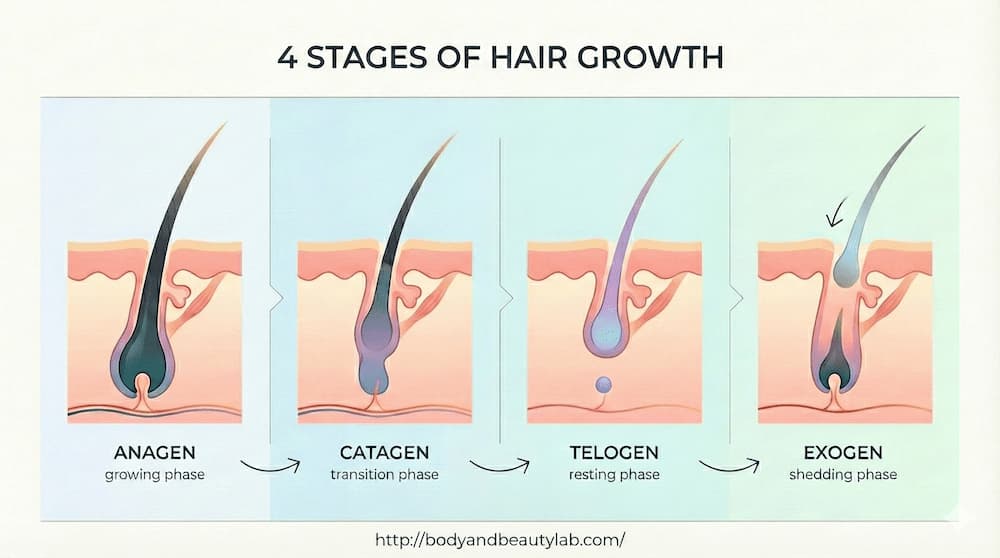 Each hair follicle follows a cycle with three main phases:
